 It is amazing what AI has brought to the table as far as technology is concerned. Some people are very concerned about it taking over their jobs, and rightly so. Others couldn’t care less! I'm somewhere in between.
I don't think many of us really know where this AI intervention is going to take us, where it is headed, or what is ultimately going to come of it. What happens to the jobs that AI and robots can do instead of us mere humans?
So, should we be afraid?
Well, to get an idea we should take a look at our history so, let's look back.
I remember being in secondary school when our maths teacher told us about how computers worked and how incredibly fast they could calculate. Yes, I am that old!
He told us that a computer could calculate an equation in an hour that would take 100 men days to do.
We all sat there in absolute awe.
At the time, computers were huge things sitting in big rooms, with all sorts of machinery whirring and spinning away as they performed their calculations. Then came the microcomputer, and computers gradually found their way into our everyday lives.
And look where we are now.
Perhaps we should go back even further, to the Industrial Revolution. Machines were introduced that could do things faster and more efficiently than people. Skills changed. Jobs disappeared. New jobs emerged. There were undoubtedly people who suffered as a result.
And yet, here we are.
The fact is, we can't stop development. New technologies, new ideas and new ways of doing things are part of who we are. Some people call it progress. Others don't.
So, back to AI.
Should we be afraid of it, or should we embrace it?
Should we learn new skills and use this technology to enhance our lives, just as we did with industrialisation and later with the computer?
There are arguments for both sides, and I think it really depends on how you look at it.
For those who fear for their jobs, there is perhaps something worth remembering.
When mass production arrived, it didn't completely kill off the artisan.
In fact, being handmade and individual arguably became more valuable.
There is still a market for people who don't want something mass-produced, despite the quality and cheap price that mass production can offer. They want something different. Something personal. Something made by a person, with all the imperfections, character and feeling that comes with it.
That is where the artisan can thrive.
And perhaps that is one of the lessons we should take into the AI age.
AI may be able to produce something quickly. It may be able to write, calculate, analyse, design and create things that once took us hours or days.
But it isn't us.
It doesn't have our experiences, our memories, our instincts, our emotions or the stories that make us who we are.
Perhaps the question isn't whether AI will replace us.
Perhaps the question is what we choose to do with it.
I use AI for the odd thing myself. I don't always agree with it and I certainly don't always do what it suggests. Sometimes I tell it that I think it's talking rubbish!
But I have to admit, it has helped me in many situations, especially when I've written something and instead of looking up a Thesaurus I use AI (same thing!). I see it as a tool, and a very good one at that. I still make the decisions. I still have the ideas. I still have the final say.
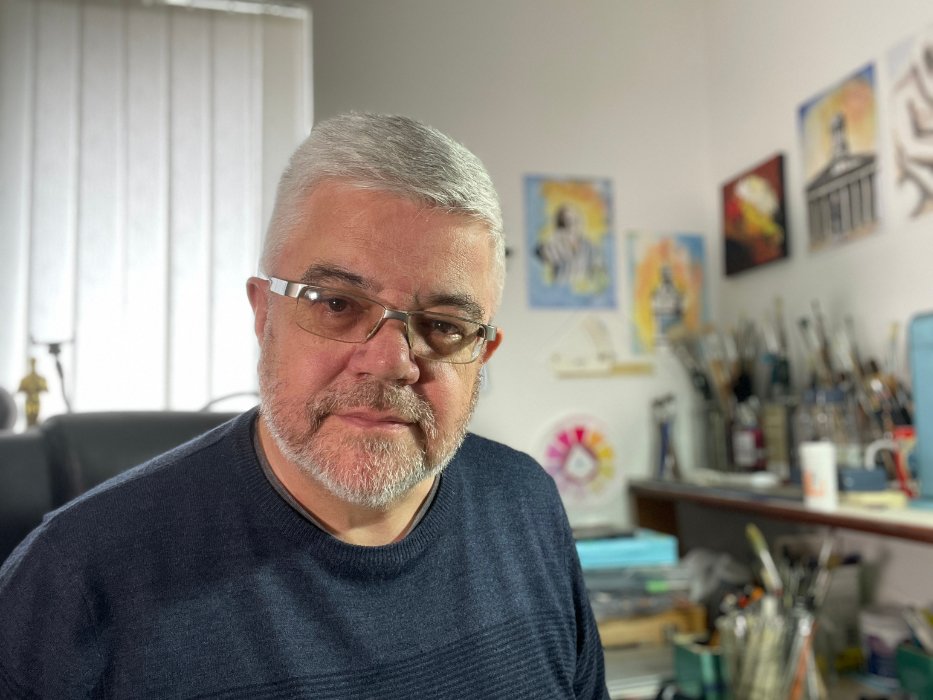
But there is one place where I don't use AI at all. My ideas. My design. My art.
When I sit down at my drawing board, what goes onto that paper comes from my heart, my head and my hand.
The ideas are mine. The marks are mine. The mistakes are mine too.
And that's important to me.
Because when someone buys one of my original artworks, I want them to own something that came from a real person. Something that I thought about, felt, sketched, changed, messed up, started again and eventually brought to life.
Could AI create something that looks like my art? Probably.
Could it produce something technically impressive? Absolutely.
But it wouldn't be my art.
And maybe that's the difference.
Technology can give us incredible tools, but there will always be something special about the things we create ourselves.
Perhaps that's how we should look at AI.
Not as something that necessarily replaces us, but as something that can help us do what we do better.
So, should we be afraid?
I'd say no, unless we're afraid of change of course!
We should accept that it is here because, frankly, it is here and we aren't going to stop it.
But perhaps we should also embrace it, learn how to use it. Work with it. Let it take away some of the tedious stuff and help us do the things we are good at.
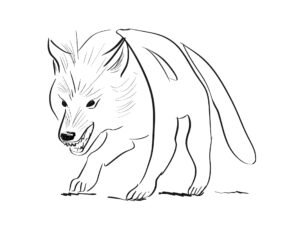
AI doesn't necessarily have to be the big bad wolf coming to blow our house down.
Maybe, if we use it wisely, it could simply be another tool in the toolbox.
And us humans have always been pretty good at inventing tools.
But here's the bit that does worry me...
There is something else about all of this that does concern me.
Look at what is happening with self-service tills, automated customer services, robots and AI. More and more companies are looking for ways to reduce the number of people they employ because, quite understandably from a business point of view, people cost money.
But I wonder if some of these big corporations are looking at the bigger picture.
Those people they are replacing are not just employees. They are also customers.
They earn money, they spend money and they keep the whole economy moving.
Robots aren't customers and they don't spend money!
If you continually replace people with machines, reduce the number of jobs available and concentrate more and more wealth in the hands of fewer and fewer companies and individuals, what happens when ordinary people simply don't have enough money to buy the things those companies are producing?
It seems to me that there is a rather nasty vicious downward circle hiding in there.
Reduce the workforce to save money.
Reduce people's incomes.
Reduce the number of people able to buy your products.
Reduce your market.
Then wonder why nobody is buying anything.
I think we need to look at things differently.
Maybe we don't need more and more enormous corporations trying to sell the same things to everyone. Maybe we need more small businesses, more independent people, more craftspeople, more artists, more makers and more local businesses serving the communities around them.
Less mass-produced everything.
More individuality.
More things made by people for people.
There will always be a place for large-scale production. I'm not suggesting we all go back to making everything by hand. But there needs to be more of a balance.
Because a healthy economy isn't just about producing things as cheaply and efficiently as possible.
It is also about people having the means to buy them.
And perhaps that is where the artisan, the small business owner and the independent worker become more important than ever.
I have believed for a long time that small businesses should be encouraged, helped and supported, in many ways, so that they can grow, employ people and provide quality products and services locally. I do honestly believe that this is the future of our own and in fact the world’s economy.
So, I would say, let's not be afraid of the big bad AI wolf, but stand up to it, embrace it and use it to our own advantage.
Keith Stoddart
Please contact me via the form adjacent or email me direct to: hello@keithstoddart.com