
Art is in the eye of the beholder.
 We’ve all heard that expression, and I suppose I’ve always accepted it. After all, art is subjective. What one person loves, another person might walk straight past without giving it a second glance.
As an artist, I love looking at art. Pretty much all kinds of it. Traditional portraiture, landscapes, line drawings, sculpture, abstract work, modern art. I’ll always give something a proper look because you never know what might catch your eye or make you think.
I’ve seen some absolutely fantastic work at exhibitions, including exhibitions at Glasgow Art Club. Paintings and drawings that have stopped me in my tracks and made me think, that’s bloody good. I can appreciate the skill, the imagination and the thought that has gone into them, even if the work isn’t anything like what I would produce myself.
But then there are other times when I stand in front of something and wonder what on earth I’m looking at.
I’ve overheard people talking about certain pieces and describing them as absolute gems, or talking about how wonderful and important they are. I look at the same piece and think, Really? Sometimes, if I’m being completely honest, I find myself thinking, I could have done better than that.
Now, I’m not saying that because I think I’m some great authority on art. I’m certainly no Picasso or Rembrandt, and I know I’ve got plenty to learn myself. But it does make me wonder about something.
Who decides what good art is?
That’s the bit of the art world I struggle with.
It sometimes seems to me that there is a particular establishment within the art world that has an enormous influence over what is considered good, important or worthy of recognition. Galleries, curators, critics, academics, collectors and other people who are involved in the art world all have their opinions, and presumably they know far more about it than I do.
But does that mean their opinion is more valid than mine?
Perhaps it is.
Perhaps they see things that I don’t.
And that is something I have to accept. I might stand in front of a painting and see very little in it, while somebody else sees something profound. That’s the nature of art. We all bring our own experiences, tastes and perceptions to it.
What I sometimes question, though, is how much of our opinion is actually our own.
If an unknown artist produces a painting that looks a bit strange, we might simply think it’s a strange painting. But tell us that it was produced by a highly respected artist, exhibited in an important gallery and praised by people within the art world, and suddenly we might start looking at it differently.
We might start searching for the meaning.
Perhaps we even feel that we should be seeing something because everybody else seems to be seeing it.
And that’s where I find myself wondering whether reputation, connections, qualifications and simply being part of the right circles sometimes have as much influence as the artwork itself.
Maybe I’m wrong. I genuinely don’t know.
I’ve always found some parts of the art world a bit… well, posh. Maybe that’s not the right word, but it can feel a little removed from ordinary people. There seems to be a language and an understanding that you are expected to have before you can really be part of it.
That’s not really me.
I’m pretty down to earth. I like art that makes me feel something. It might make me smile, make me think, remind me of something or simply make me stop and look. I don’t necessarily need to know what the artist was thinking when they made it.
And I certainly don’t think I should need an art degree to decide whether I like it.
That’s not to say I don’t appreciate abstract art. I do. I’ve seen some fantastic abstract work that I can really connect with. I might not know exactly what it represents, but the colours, shapes, marks or composition can create a feeling or tell me something.
I’ve also seen abstract work that leaves me completely cold.
But perhaps that’s OK.
Maybe the artist has expressed exactly what they wanted to express, and I’m simply not the person it was meant to connect with.
The question becomes more difficult when a piece receives enormous praise and I genuinely cannot see what all the fuss is about. Is there something I’m missing, or is it simply that the people praising it have a different way of looking at art?
And if that’s the case, who is right?
Maybe neither of us.
Maybe both of us.
Perhaps there shouldn’t be a “right” answer.
That’s what makes this whole thing so interesting. Art doesn’t have to pass an exam. There isn’t necessarily a set of rules that says a painting has to reach a certain standard before it can be called art.
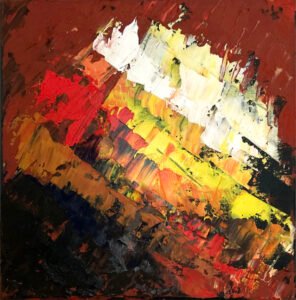
And that brings me to a wee painting I have sitting in my studio called Fire at Sea.
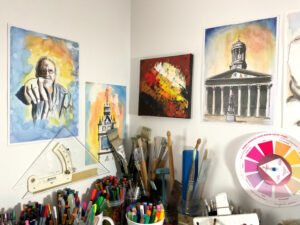 I was finishing another piece of artwork and still had quite a lot of oil paint left on my palette. I didn’t want to waste it, so I decided to put it onto a canvas. I had no plan. I wasn’t setting out to create another painting. I just started slapping the leftover paint onto the canvas, moving it around and seeing what happened.
Then, all of a sudden, I started to see something in it.
I liked what I was looking at.
So I kept going. I worked on it, developed what I could see and eventually finished it. I called it Fire at Sea, and it now sits in my studio.
Now, was it art when I first started putting that leftover paint onto the canvas?
I don’t know.
It was certainly paint on a canvas, but there was no thought or intention behind it. It was simply paint I didn’t want to throw away.
At some point, though, something changed. I started seeing something in those random marks and colours. I began making decisions about where the painting should go, and eventually I had created something that I considered a finished piece of art.
And that makes me wonder whether art is sometimes created deliberately and sometimes discovered almost by accident.
Perhaps somebody else could look at Fire at Sea and think it’s rubbish.
That’s their right.
Somebody else might see exactly what I saw when I started working on it.
And somebody else might see something completely different.
Maybe that’s the point.
If someone wants to throw paint at a canvas and call it art, that’s up to them. If someone else wants to spend six months painstakingly painting every tiny detail of a landscape, that’s up to them too.
I might look at the first one and think it looks like a dog’s dinner, while somebody else sees something I completely missed.
And perhaps that’s OK.
I love art. I love seeing what other people create and I love the fact that we can all look at the same thing and see something completely different.
What I don’t like is the idea that somebody else can tell me what I should consider good art.
Tell me what you see.
Tell me why a piece means something to you.
Tell me why it moves you, makes you think or makes you smile.
I’ll listen.
But I reserve the right to look at it and say…
“Sorry, I just don’t get it.”
And perhaps that’s OK too.
Because in the end, art really is in the eye of the beholder.
Even if the beholder happens to be me.